

Tuan Anh Vu
Reflection Paper
May 24th, 2025
Your view on the role of Internet resources and critical national Internet infrastructure (.vn domain name, IP/ASN, DNS, VNIX, …) in implementing the goal of innovation, creativity, and breakthrough in the spirit of Resolution No. 57-NQ/TW of the Politburo. Propose innovative ideas in the effective use of Internet resources and important national Internet infrastructure
I. Introduction
In the context of globalization and the rapid advancement of the Fourth Industrial Revolution, science, technology, innovation, and digital transformation have emerged as key drivers of national development. In Vietnam, Resolution No. 57-NQ/TW, issued by the Politburo on December 22, 2024, explicitly states: “The development of science, technology, innovation, and national digital transformation is a paramount breakthrough and the primary force for rapidly advancing modern productive forces” [1]. To achieve these strategic objectives, Internet resources and critical national Internet infrastructure—including the .vn domain, IP addresses/ASNs, the Domain Name System (DNS), and VNIX (Vietnam Internet Network Information Center)—serve as indispensable foundations. These components not only enable connectivity and the operation of digital services but also foster innovation, technological breakthroughs, and comprehensive digital transformation.
This essay will analyze in detail the role of each element of Internet resources and national Internet infrastructure in realizing the goals of Resolution No. 57-NQ/TW. Additionally, it will propose creative ideas to optimize the use of these resources, driving Vietnam’s sustainable development in the digital era.
II. The Role of Internet Resources and National Internet Infrastructure
1. National Domain Name (.vn)
The .vn domain is a vital Internet resource, serving to identify and authenticate Vietnamese organizations, businesses, and individuals in global cyberspace. According to the Vietnam Internet Network Information Center (VNNIC), “The .vn domain is not merely an Internet address but also a national brand, contributing to affirming Vietnam’s digital sovereignty” [2]. With Resolution No. 57-NQ/TW aiming for “the digital economy to account for at least 30% of GDP by 2030” [1], the .vn domain becomes a strategic tool for Vietnamese businesses to build online brands, promote e-commerce, and develop innovative digital services.
Supporting Innovation: The .vn domain enables startups and research organizations to establish an online presence with a distinct Vietnamese identity, facilitating access to both domestic and international markets. For instance, a VNNIC program offering free .vn domains with the “id.vn” suffix to youths aged 18-23 has spurred digital creativity among the younger generation [3].
Protecting Brands and Cybersecurity: Managed by VNNIC, the .vn domain enhances security and safeguards the national brand, aligning with the Resolution’s call for “national data security and safety” [1].
2. IP Addresses and ASNs
IP addresses (Internet Protocol) and Autonomous System Numbers (ASNs) are fundamental resources ensuring connectivity between devices and networks on the Internet. VNNIC notes: “IP addresses are essential for devices to communicate online, while ASNs manage and route traffic between independent network systems” [4]. With IPv4 addresses (limited to 4.3 billion) nearing exhaustion, transitioning to IPv6—with its vast address space () is critical to support emerging technologies like 5G, the Internet of Things (IoT), and cloud computing [5].
Supporting Strategic Technology Development: Resolution No. 57-NQ/TW emphasizes “mastering strategic and core technologies” [1]. IPv6 and ASNs provide the backbone for deploying IoT and 5G, key priorities in Vietnam’s national technology strategy [1].
Promoting Digital Transformation: Effective management of IP addresses/ASNs enables organizations to roll out new digital services, supporting goals such as “nationwide 5G coverage” and “completing smart city development” by 2030 [1].
3. Domain Name System (DNS)
The DNS functions as the “Internet’s phone book,” translating domain names into IP addresses for users to access online services. VNNIC highlights that “the national DNS system is a critical part of Internet infrastructure, ensuring stability and security for online activities” [6]. Given the Resolution’s demand for “advanced, modern digital infrastructure with ultra-large capacity and ultra-broadband” [1], DNS is central to maintaining stable and secure connectivity.
Ensuring Stability and Security: A robust DNS system sustains uninterrupted digital services, supporting innovation and digital transformation. DNS Security Extensions (DNSSEC) further bolster security, meeting the Resolution’s “network security and safety” requirements [1].
Supporting New Applications: DNS underpins high-tech applications like IoT and artificial intelligence (AI), identified as strategic technologies to master in the Resolution [1].
4. VNIX (Vietnam Internet Network Information Center)
VNIX, the national Internet exchange point, enables Internet service providers (ISPs) to exchange traffic directly, reducing latency and optimizing connection costs. VNNIC states: “VNIX alleviates the burden on international connections, saving costs and enhancing bandwidth efficiency” [7]. This aligns with the Resolution’s goal of developing “modern, synchronized, secure, and safe digital infrastructure” [1].
Optimizing Internet Infrastructure: VNIX improves domestic Internet access speed and quality, supporting bandwidth-intensive services like video streaming and online gaming, thus boosting the digital economy.
Supporting Digital Economy Growth: By lowering connectivity costs and improving network efficiency, VNIX contributes to the target of “the digital economy reaching at least 30% of GDP” [1].
III. Alignment with the Goals of Resolution No. 57-NQ/TW
Resolution No. 57-NQ/TW outlines specific targets for 2030, including:
- “Achieving advanced levels of science, technology, and innovation in key fields” [1].
- “The digital economy constituting at least 30% of GDP” [1].
- “Developing modern, synchronized, secure, and safe digital infrastructure” [1].
Internet resources and national Internet infrastructure are foundational to these objectives:
- Strategic Technology Development: The .vn domain, IP addresses/ASNs, and DNS enable the deployment of technologies like IoT, AI, and Big Data—priority areas in the Resolution [1].
- Digital Transformation: A strong Internet infrastructure, bolstered by VNIX, ensures fast and efficient connectivity, facilitating digital transformation across sectors like agriculture, healthcare, and transportation [1].
- Network Security and Safety: Rigorous management of Internet resources protects national data and reinforces digital sovereignty, fulfilling the Resolution’s mandate to “ensure network safety, security, and national sovereignty in cyberspace” [1].
IV. Creative Proposals for Effective Use of Internet Resources and National Internet Infrastructure
To illustrate these innovative ideas, the infographic below highlights the main features and benefits of each proposal.
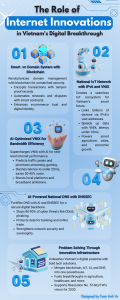
To maximize the potential of Internet resources and national Internet infrastructure, foster innovation, grow the digital economy, and assert Vietnam’s digital sovereignty, I propose the following ideas. Each is detailed with technical aspects, benefits, real-world examples, and implementation roadmaps.
1. Developing a Smart .vn Domain System Integrated with Blockchain
The current .vn domain management system relies on centralized mechanisms, making it susceptible to attacks like domain hijacking or data forgery. I propose a blockchain-integrated smart .vn domain system using distributed ledger technology to manage the domain lifecycle—registration, transfer, renewal, and revocation. Transactions will be encrypted and stored as immutable records on the blockchain, ensuring transparency, security, and traceability.
Operating Mechanism:
- Each .vn domain is linked to a unique blockchain hash.
- Users register domains via a blockchain-connected web interface or app, reducing reliance on traditional intermediaries.
- Blockchain nodes (operated by VNNIC and partners) validate transactions using consensus algorithms like Proof of Stake (PoS) or Practical Byzantine Fault Tolerance (PBFT), balancing decentralization with legal compliance.
- Smart contracts automate processes like renewals, payments, and dispute resolution.
Additional Features:
- Access delegation: Subdomain usage rights can be granted without altering primary ownership, recorded on the blockchain.
- Identity verification: Integration with the national digital identity system (VDID) ensures registrant legitimacy, minimizing fraud.
Benefits
- Enhanced Security: Blockchain prevents DNS spoofing and domain hijacking through distributed, encrypted data storage.
- Transparency: Public blockchain records allow users to verify domain ownership and status anytime.
- E-commerce Support: Blockchain-backed .vn domains act as trusted “digital certificates” for commercial websites, boosting online transaction confidence.
- Digital Sovereignty: Pioneering blockchain in domain management elevates Vietnam’s global tech standing, aligning with the Resolution’s “technological breakthrough” goal [1].
- Cost Reduction: Smart contracts reduce manual labor for tasks like dispute resolution.
Practical Examples
- Ethereum Name Service (ENS): A decentralized domain system on Ethereum, ENS has managed over 2.5 million domains (e.g., “example.eth”) by 2023, proving blockchain’s viability [8].
- Namecoin: This blockchain project manages .bit domains to enhance security and resist censorship.
Implementation Roadmap
- Phase 1 (6 months): Research and develop a basic blockchain platform with companies like FPT or Viettel Solutions, creating a private blockchain for legal compliance.
- Phase 2 (12 months): Pilot the system for specific domains (e.g., .gov.vn or large enterprises), testing stability and security.
- Phase 3 (18-24 months): Expand to all .vn domains, integrating with VNNIC’s DNS system and training users.
- Phase 4 (long-term): Add features like subdomain delegation and NFT-linked domains for added value.
Challenges and Solutions
- Challenge: High initial costs and technical complexity.
- Solution: Secure funding from national innovation funds and public-private partnerships (PPP), leveraging open-source tech communities.
2. Building a National IoT Network Based on IPv6 and VNIX
The Internet of Things (IoT) is a future inevitability, yet Vietnam lacks a unified national IoT network. I propose creating one using IPv6’s vast address space () and VNIX’s domestic data transit capabilities to connect billions of IoT devices in agriculture, healthcare, transportation, and smart cities.
Operating Mechanism:
- IPv6: Each IoT device (e.g., sensors, cameras) receives a unique IPv6 address, overcoming IPv4’s limitations and enabling billions of connections without NAT.
- VNIX: Acts as an “IoT data hub,” routing domestic traffic to reduce latency and costs.
- 5G Integration: Combines with 5G for high-speed, real-time IoT applications like autonomous vehicles.
Applications:
- Precision Agriculture: Sensors monitor soil and weather, sending data via IPv6 to VNIX for automated irrigation.
- Smart Traffic: Cameras in Hanoi and Ho Chi Minh City send real-time data to VNIX for traffic light optimization.
- Remote Healthcare: Wearables transmit health data to doctors seamlessly.
Benefits
- Unlimited Connectivity: IPv6 supports near-infinite IoT devices for decades.
- Traffic Optimization: VNIX cuts domestic latency to under 10ms (vs. 50-100ms internationally), reducing bandwidth costs.
- Smart Cities: Supports projects like Da Nang’s smart city initiative.
- Resolution Alignment: Advances “IoT mastery” and “digital economy growth” [1].
- Competitiveness: Aligns Vietnam with IoT leaders like South Korea and Singapore.
Practical Examples
- South Korea: Uses IPv6 for IoT in smart buildings and traffic management, with over 50% of devices on IPv6 by 2022 [9].
- Singapore: The Smart Nation project connects environmental sensors nationwide via IPv6.
Implementation Roadmap
- Phase 1 (6-12 months): Assess IPv6 readiness with operators like Viettel and VNPT, upgrading VNIX for IoT.
- Phase 2 (12-18 months): Pilot in key areas (e.g., smart farms in Lam Dong, traffic systems in Hanoi).
- Phase 3 (18-36 months): Expand nationwide, incentivizing IPv6-compatible IoT devices with tax breaks.
- Phase 4 (long-term): Integrate AI and Big Data for enhanced IoT services like weather prediction.
Challenges and Solutions
- Challenge: Limited IPv6-compatible devices and business awareness.
- Solution: Support local IoT manufacturers and conduct awareness workshops.
3. Optimizing VNIX with AI for Large Bandwidth Services
VNIX is vital but under-optimized for bandwidth-heavy services like streaming (YouTube, Netflix), gaming (League of Legends), and conferencing (Zoom). I propose integrating AI into VNIX to predict, manage, and allocate bandwidth intelligently.
Operating Mechanism:
- Traffic Prediction: AI uses LSTM models to forecast peak usage (e.g., 8-10 PM).
- Bandwidth Allocation: AI prioritizes real-time services like streaming.
- Anomaly Detection: AI identifies DDoS attacks or congestion, triggering instant mitigation.
Additional Features:
- Regional optimization: Tailors bandwidth to local needs (e.g., Hanoi vs. Da Nang).
- Domestic CDN support: Stores popular content closer to users.
Benefits
- Performance: Cuts latency from 50ms to under 20ms domestically.
- Cost Savings: Reduces international bandwidth costs by 30-40%.
- Digital Economy: Strengthens local platforms (e.g., VieON) against global competitors.
- Resolution Alignment: Meets “modern, ultra-broadband infrastructure” goals [1].
- Resilience: AI adapts to traffic fluctuations, preventing overload.
Practical Examples
- AMS-IX: Uses AI to manage 10Tbps of daily traffic efficiently [10].
- Google: Optimizes YouTube bandwidth with AI, cutting costs by 15%.
Implementation Roadmap
- Phase 1 (6 months): Collect VNIX traffic data for AI training, partnering with experts from VinAI.
- Phase 2 (12 months): Test AI on Hanoi and Ho Chi Minh City nodes for streaming and gaming.
- Phase 3 (18-24 months): Expand AI across VNIX, integrating with content providers like POPS Worldwide.
- Phase 4 (long-term): Develop AI tools for CDNs and IoT support.
Challenges and Solutions
- Challenge: Limited initial data and high costs.
- Solution: Use VNNIC historical data and seek funding from content providers.
4. Developing a National DNS System with AI and DNSSEC
The national DNS system faces threats like DDoS and phishing. I propose integrating AI for real-time threat detection and DNSSEC for data authentication to create a secure, smart DNS system.
Operating Mechanism:
- AI: Uses deep learning (e.g., CNN) to detect abnormal DNS patterns (e.g., DDoS signals).
- DNSSEC: Digitally signs .vn domain records to prevent tampering.
- Integration: AI responds to threats; DNSSEC ensures data integrity.
Additional Features:
- Smart filtering: Blocks malicious queries using global and local blacklists.
- Real-time response: Reroutes traffic to backup servers during attacks.
Benefits
- Cybersecurity: Cuts DNS attack risks by 80-90%.
- Resolution Alignment: Ensures “network security and sovereignty” [1].
- Digital Services: Secures platforms like online banking and e-commerce.
- Reputation: Boosts global trust in Vietnam’s Internet infrastructure.
- Scalability: Handles millions of queries per second.
Practical Examples
- Cisco Umbrella: Uses AI to block 7 million daily threats [11].
- Cloudflare 1.1.1.1: Implements DNSSEC for billions of queries.
Implementation Roadmap
- Phase 1 (6 months): Deploy DNSSEC on key domains (e.g., .gov.vn), collect data for AI.
- Phase 2 (12-18 months): Integrate AI, test threat detection in Hanoi and Ho Chi Minh City.
- Phase 3 (18-24 months): Extend DNSSEC to all .vn domains, upgrade systems for AI scale.
- Phase 4 (long-term): Build a DNS monitoring center with AI threat prediction.
Challenges and Solutions
- Challenge: User unfamiliarity with DNSSEC and high upgrade costs.
- Solution: Promote DNSSEC benefits and subsidize ISPs.
References
[1] Politburo, “Resolution No. 57-NQ/TW on the breakthrough development of science, technology, innovation, and national digital transformation,” Hanoi, December 22, 2024. [Cited from file: https://tulieuvankien.dangcongsan.vn/Uploads/2025/1/7/2/NQ-57-TW-BCT.pdf, page 1].
[2] VNNIC, “The .vn domain – Vietnam’s national brand on the Internet,” [Cited from file: https://drive.google.com/file/d/1cCHk0L9lqlcTsUiI63dnjmBvxuWO_gab/view?usp=drive_link, page 15].
[3] VNNIC, “Program for the application of the national .vn domain for students,” [Cited from file:https://drive.google.com/file/d/1wg93zuUDSMuRd1iDFZ0YPPSKwqxuaKgi/view?usp=drive_link, page 1].
[4] VNNIC, “Architecture and Internet network resources,” [Cited from file: https://drive.google.com/file/d/1cCHk0L9lqlcTsUiI63dnjmBvxuWO_gab/view?usp=drive_link, page 20].
[5] VNNIC, “Overview of IPv6 & the role of IPv6 in 5G/IoT,” [Cited from file: https://drive.google.com/file/d/1wDbvNF8BKXe3lFPSUZIPPEEgpeqYypVD/view?usp=drive_link, page 4].
[6] VNNIC, “National DNS system,” [Cited from file: https://drive.google.com/file/d/1cCHk0L9lqlcTsUiI63dnjmBvxuWO_gab/view?usp=drive_link, page 25].
[7] VNNIC, “VNIX – Vietnam Internet Network Information Center,” [Cited from file: 1. https://drive.google.com/file/d/1cCHk0L9lqlcTsUiI63dnjmBvxuWO_gab/view?usp=drive_link, page 30].
[8] Ethereum Name Service, “Blockchain-based domain name system,” [Online]. Available: https://ens.domains/.
[9] Smart Nation Singapore, “IoT applications in Singapore,” [Online]. Available: https://www.smartnation.gov.sg/.
[10] AMS-IX, “Amsterdam Internet Exchange,” [Online]. Available: https://www.ams-ix.net/.
[11] Cisco, “AI-powered DNS security,” [Online]. Available: https://www.cisco.com/c/en/us/products/security/dns-layer-security.html.
